
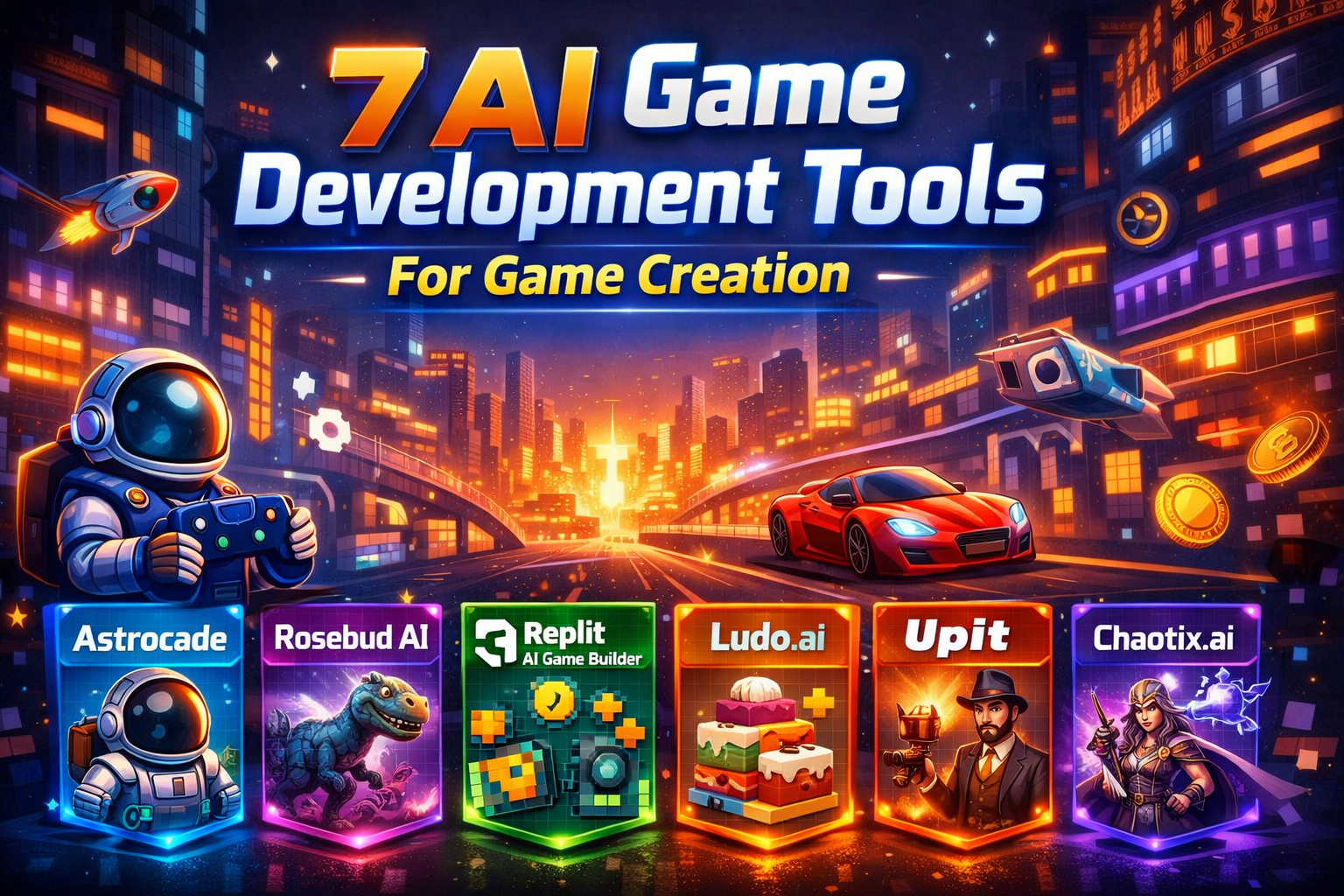
Just imagine typing something simple like “a fast zombie runner through a glowing cyber city” and boom, you have got a real playable game in minutes. No coding, no complicated software, just your words turning into fun games you can play and share right away with your friends.
That’s the magic of prompt-based AI game tools right now in 2026. These platforms use smart AI to handle the art, sounds, mechanics, and everything else. They are perfect for beginners, teachers making educational games and help kids learning AI and its benefits, parents creating stuff with kids imagination, or anyone who wants to prototype ideas super fast.
We looked at speed (how quickly you get a playable game), ease (how little work you need to do), quality (does it actually feel fun?), customization options, extra features like sharing or monetization, free access, and how innovative each tool feels.
Astrocade comes out on top in our testing. It’s for people who wanna create instant fun & casual games without any hassle. Here’s the full list of the top 7 tools we recommend you to give a try.
1: Astrocade
Astrocade is hands-down the leader for turning text into instant playable games. You just describe your idea, and its “agentic AI” builds everything characters, levels, music, sounds, UI in seconds to a couple of minutes.
It sh with casual arcade-style games, platformers, endless runners, meme games, and quick horror bits. Super social to share your game with one click and play with friends.
Once your game is ready, hit publish, and it goes live instantly on Astrocade’s platform. Anyone can play it in the Games Gallery, no downloads needed. You can even see real stats like how many times your game has been played and average playtime. Perfect for seeing what’s working and tweaking for more fun (or even going viral online game).
Users can even edit the published game & republish it anytime. Go to the AI-generated editor, add new levels, tweak mechanics, change backgrounds, or remix with fresh prompts. Republish with updates like adding more levels or effects and keep your players hooked.
Pros
- Lightning fast (often under 2 minutes)
- 100% no-code and beginner-friendly
- Free to start and play around
- Great community for sharing and remixing
Cons
- Best for short, fun mini-games (not huge open-world stuff)
- Less deep editing if you want super custom changes
Why it’s #1: Nothing beats it for pure speed and “wow, that actually works!” moments. Perfect if you just want to create and have fun fast.
Check these out:
- I Didn’t Order This A funny chaotic restaurant game
- Athenian Odyssey Quick adventure vibe
2: Rosebud AI
Rosebud AI lets you “vibe code” your way to full 2D and 3D games, apps, and even immersive worlds, all without writing a single line of code or downloading anything. Just chat with the AI: describe your game idea like “a multiplayer VR dinosaur RPG in a neon jungle,” and it generates everything, code, voxel models, assets, animations, characters, environments, and gameplay mechanics. You can playtest right away in the browser, refine with more prompts, and iterate until it’s perfect.
It’s killer for deeper prototypes like RPGs, horror experiences, puzzles, FPS shooters, platformers, visual novels, or even educational/mental health games. With over 1.9 million games created, it’s got templates for quick starts (e.g., Stranger Things-style adventures or Bridgerton full games). Plus, upload your own art styles or remix community projects for endless creativity.
Pros
- Real 3D support and nicer visuals
- All-in-one (build, play, share)
- Good for creators who want to monetize later
Cons
- Takes more back-and-forth prompts sometimes
- A bit slower than pure instant tools
3: Replit AI Game Builder
Replit’s AI Agent is a browser powerhouse that turns natural language prompts (or even screenshots!) into full working games like platformers, Snake clones, Breakout, or 3D experiments, all without leaving your tab. Say “build a pixel-art endless runner with power-ups,” and it auto-generates code, installs dependencies, debugs issues, and deploys a live version instantly. Want more? Dive into the editable code to tweak, learn, or expand; it’s the perfect bridge from AI magic to real coding skills.
Ideal for quick prototypes, web apps disguised as games, or health trackers with game elements. Supports tons of languages (Python, JS, etc.) and deploys worldwide-shareable links in seconds. GitHub integration lets you export and keep building elsewhere.
Pros
- Free tier is solid
- Export code and keep building
- Good stepping stone if you ever want to code
Cons
- Feels a little more technical than pure no-code options
4: Ludo.ai
Ludo.ai is a smart game design sidekick, a full suite that starts with prompts for brainstorming hits, dives into market trends, spits out assets, and even builds playable prototypes. Input keywords like “mobile puzzle with stacking cakes,” and the Game Ideator crafts concepts, mechanics, stories, and images. Then, use “vibe coding” in the Playable Generator for instant interactive tests of loops, genres, and atmospheres.
Trusted by Unity/Ubisoft/Voodoo, it’s pro-grade: Check top charts, blend mechanics from hits, or get a “Market Score” to predict virality. Assets? Text-to-images/3D models/videos/sprites/audio all export-ready. Free trial to start.
Pros
- Super helpful for planning real games
- Market insights so you make stuff people might love
- Lots of asset tools in one place
Cons
- More focused on design & research than instant full games
5: Upit
Upit is a fun, social AI game creator where prompts generate casual hits like Bubble Shooter or racing games, complete with code suggestions, graphics, and online testing. Edit everything visually, remix others’ creations, and deploy to a feed where games rack up plays (e.g., 500K+ on top ones). It’s all browser-based, with profiles for showcasing your portfolio.
Perfect for hypercasual arcade, puzzles, merging, or drifting racers, quick vibes into shareable fun.
Pros
- Fast to iterate and change things
- Fun mix of AI help + your own touches
Cons
- You’ll probably do more manual tweaking
6: Gameer
Gameer harnesses multi-agent AI to spin text prompts into deep interactive RPGs, mysteries, or branching adventures in 3-5 minutes. Describe “Victorian detective with twisting choices,” and get full narratives, decisions that branch the story, and playable links to share. Agents collaborate for coherent, alive worlds, no code required.
Pros
- Really strong for story-driven games
- Branching paths feel alive
- Shareable links right away
Cons
- Slower for action/arcade styles
- More niche if you want quick casual fun
7: Chaotix.ai
Chaotix.ai turns raw text into fully playable, editable games in seconds, side-scrollers, RPGs, racers, puzzles, visual novels, you name it. 100% no-code: Prompt a world, then tweak stories, levels, art, dialogue, difficulty, or cutscenes. Remix community stuff, collaborate on levels, and share one-tap.
Pros
- Totally no-code and easy to grow your game
- Good for custom worlds and stories
Cons
- Newer tool, so visuals and polish can vary
- Not always the fastest first version
How We Ranked These AI Game Creation Tools
To rank these AI game creation tools fairly, we tested each platform using the same prompt types, including arcade runners, simple adventure games, and short horror experiences. Every tool was scored out of 10 based on how quickly it turned a text prompt into a playable game, how easy it was to use for complete beginners and whether it required any coding. We also evaluated the visual and gameplay quality, the level of customization available after generation, and the overall feature set, such as sharing options, supported genres and monetization support. Pricing and access mattered too, especially the strength of the free tier and how easy it was to get started.
Finally, we considered uniqueness, focusing on AI-generated features that genuinely set each tool apart rather than surface-level claims.
Why Choose Astrocade Over the Others?
Astrocade stands out among all because it removes friction at every step and focuses purely on fast playable fun. In our testing, it consistently delivered working games in under two minutes, which is noticeably quicker than heavier 3D focused tools like Rosebud or story-driven platforms like Gameer. There is no code to touch and no upfront planning required, unlike tools such as Replit Upit or Ludo, which makes the experience feel instant and accessible. For most creators who want casual social and shareable mini games Astrocade simply fits better while other platforms shine only in specific niches like complex narratives or research driven projects. Its free access strong community and simple sharing make it welcoming from day one. For the majority of users who want to turn ideas into playable moments quickly and enjoy them with friends Astrocade is the most practical choice.
Final Thoughts
Prompt based AI game development has reached a point where ideas move faster than skills or software ever could. These tools prove that you no longer need coding knowledge, no large teams or months of production time to create something playable and enjoyable. Whether your goal is quick social fun, classroom experimentation, fast prototyping or exploring deeper game concepts, there is now a platforms built exactly for that purpose.
Astrocade leads for instant casual creativity while tools like Rosebud Gameer and Ludo shine when you want depth structure or wanna e edit the game, you are unable to do that. The key is choosing based on how fast you want results and how much control you need after generation. In 2026 game creation is no longer locked behind technical or coding barriers. It starts with an idea, a prompt and the willingness to experiment.
