
Interest in global accounting careers keeps rising among Indian students. Remote roles, US clients, and dollar-linked pay attract attention fast. Somewhere in every discussion, one question shows up early. What is CPA, and can Indian students even qualify?
The short answer is yes. Indian students can meet CPA eligibility with the right academic planning. The longer answer matters more. This blog breaks down CPA eligibility for Indian students in simple language, without legal jargon or exam hype.
What Is CPA, and why do Indian Students Care
You are here because you must be wondering – What is CPA? So, the CPA stands for Certified Public Accountant, a US-based professional license regulated by state boards. It focuses on accounting, auditing, taxation, and business law tied to US standards.
Indian students care about CPA because it travels well. It works with US firms, global accounting teams, consulting roles, and remote jobs serving American clients. Unlike local certifications, a CPA does not depend on geography.
That global acceptance pushes many Indian commerce and finance students to check CPA eligibility early.
CPA Eligibility Basics Explained Simply
CPA eligibility depends on three areas:
- Education
- Examination
- Experience
Each US state board sets its own CPA eligibility rules. Still, the core structure stays similar across states.
For Indian students, education creates the biggest confusion. Let’s clear that first.
Educational Requirement for CPA Eligibility
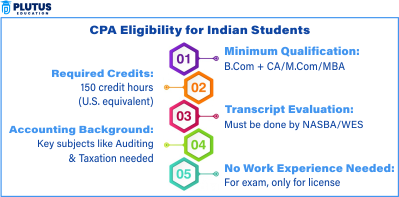
Most state boards follow the 150 credit hour rule. This equals roughly five years of higher education under the US system.
Indian degrees work differently. Indian universities use years, not credits. So CPA eligibility depends on degree type and extra qualifications.
BCom Students
A standard three-year BCom alone usually falls short of CPA eligibility. Most state boards ask for more credits than BCom provides.
BCom students often add:
- MCom
- MBA
- PG Diploma in Accounting or Finance
With these additions, CPA eligibility becomes achievable.
BCom Plus CA Inter or CMA Inter
Many state boards accept CA Inter or CMA Inter along with BCom. This combination often meets CPA eligibility faster than doing a full master’s degree.
Chartered Accountants
Indian CAs usually meet CPA eligibility across most states, since their education and training are taken seriously during evaluation.
MBA Graduates
MBA graduates with accounting and finance subjects often meet CPA eligibility. Transcript review still matters, but most MBAs clear the bar.
Credit Evaluation for Indian Students
Indian degrees go through credential evaluation. Third-party agencies convert Indian marks and years into US credit hours.
This step decides CPA eligibility more than the degree title itself.
Subjects that matter most:
- Financial accounting
- Auditing
- Taxation
- Business law
- Cost accounting
Students missing accounting-heavy subjects may need bridge courses.
Age Limit and Nationality Rules
There is no age limit for CPA eligibility. Indian students in their early twenties and professionals in their thirties both qualify.
Nationality does not block CPA eligibility either. Indian citizens can register, write exams, and earn the CPA license.
Some states ask for a Social Security Number at the license stage, not the exam stage. Many Indian candidates choose states without SSN rules.
CPA Exam Structure for Indian Students
What is the CPA exam format? Four papers:
- Financial Accounting and Reporting
- Auditing and Attestation
- Regulation
- Business Environment and Concepts
Indian students can write the CPA exams from India at Prometric centres. No travel to the US needed.
Passing all four within an 18-month window completes the exam requirement under CPA eligibility.
Work Experience Requirement
CPA eligibility also includes work experience. Most states ask for one to two years under a licensed CPA.
For Indian students, this experience can happen:
- In India
- In US firms with Indian offices
- In global accounting firms
The supervisor must hold an active CPA license.
Work experience usually follows exam completion, though a few states permit both to run together.
Planning CPA Eligibility Early as a Student
Students still in college gain an advantage by planning for CPA eligibility early.
Smart steps include:
- Choosing accounting-heavy electives
- Adding MCom or professional diplomas
- Keeping transcripts organized
This reduces delays during evaluation.
Career Options After Doing CPA
- US taxation specialist
- Audit associate for US clients
- Remote accounting manager
- Advisory roles in global firms
Pay scales rise faster compared to non-CPA roles. Remote flexibility improves. Career mobility expands.
Final Thought
CPA eligibility for Indian students is not complicated. It just needs planning and clarity. Knowing what CPA is, how education credits convert, and which state boards fit Indian profiles makes the process smooth. For students looking for structured guidance during this journey, Zell Education often comes up naturally in CPA preparation conversations.
