
Years of work experience do not have to be the foundation stone in making a career in risk management. For finance students or freshly graduated students aspiring to enter the area of finance, banking, risk management, or investment, taking up an FRM course is very advantageous to learn specific skills regarding financial risks before starting off their careers.
The Financial Risk Management (FRM) exam organised by GARP is specifically designed to test candidates in the areas of market risks, operational risks, credit risks, and risk management practices. Although certification and relevant experience form a significant part of the FRM certification process, there is no requirement for previous experience before taking up preparation for the exam.
FRM Course Without Prior Experience: A Complete Guide
1. You Can Take the FRM Exam Without Work Experience
One of the significant advantages of the FRM course is that candidates do not need prior professional work experience to register for or take FRM examinations. Students, fresh graduates and professionals from non-risk backgrounds can start their FRM journey without first working in a risk-management role.
The Global Association of Risk Professionals (GARP) administers the FRM qualification. Candidates can take the exams while studying or at the start of their careers. This makes the course a potential way to build foundational knowledge in areas like market risk, operational risk, credit risk and quantitative analysis before entering the field.
2. Work Experience Is Required to Earn the FRM Certification
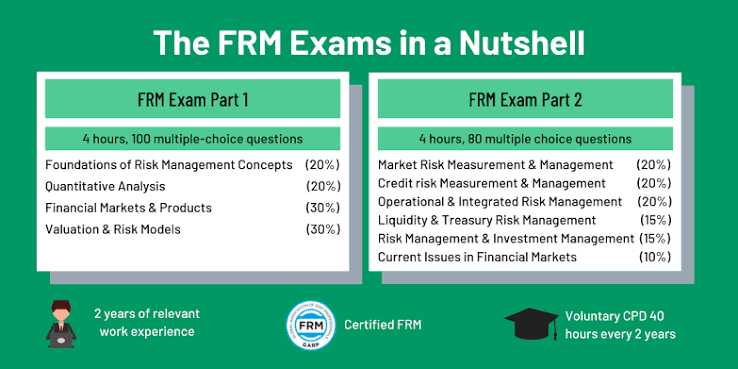
Although work experience is not required to sit for FRM exams, candidates must meet GARP’s professional experience requirement to receive certification. GARP requires candidates to have two years of relevant full-time professional work experience in Financial Risk Management (FRM).
Candidates do not need to complete this experience before taking the exams. Candidates can complete the required experience before or after passing FRM Part 1 and Part 2, subject to GARP’s certification requirements. Therefore, a student or fresher can clear exams first and build required professional experience afterwards.
3. Freshers Can Use FRM to Build Risk-Management Knowledge
For those who lack any form of working experience, pursuing an FRM can provide exposure to key concepts applied in risk management. This includes topics such as financial markets and instruments, quantitative analysis, market risk, valuation and risk modelling, liquidity risk and operational risk concepts.
Nonetheless, having completed the Financial Risk Management (FRM) certificate does not necessarily make one eligible for a risk management job. Factors such as academic credentials, internships, technical skills, and software knowledge can be taken into account. It is thus important that the candidate views FRM as just one component of career preparation.
4. Internships and Entry-Level Roles Can Help Build a Career
Candidates without any work experience could first aim for internship opportunities and jobs that have anything to do with finance, risk, and analytics. Jobs such as risk analysis, market research, credit analysis, risk reporting, and financial analysis, among others, can help candidates understand how organisations apply financial risk management.
Candidates must also pay attention to the type of experience they build because GARP’s professional experience requirement is specific to risk management. Before assuming that a particular job will satisfy the certification requirement, candidates should check GARP’s current eligibility guidance and ensure their responsibilities are relevant to required professional experience.
5. FRM Certification Can Be Started by Students and Graduates
FRM is accessible to students and recent graduates as there is no requirement to have completed a specific finance degree or accumulated prior work experience before taking exams. Candidates from backgrounds like finance, economics, accounting, engineering, mathematics and other quantitative disciplines can consider the qualification if they meet exam requirements.
It is advisable that students gain an understanding of the syllabus level before joining the FRM course. Quantitative analysis, statistics, probability, risk models, and financial markets are some key topics included in the syllabus. With a clear understanding of the topics, the learning process becomes more comfortable, particularly for those who have never been exposed to financial knowledge before.
6. Passing FRM Exams and Becoming Certified Are Different
The candidates must be aware that passing the FRM Part 1 exam and the FRM Part 2 exam does not equate to having the Financial Risk Management (FRM) certification. Passing the exam shows that the candidate has met GARP’s exam requirements, but certification also requires meeting GARP’s professional experience requirements.
This distinction is important for freshers! A certification can begin FRM prep, pass both exams and then continue developing a career in risk management while working towards the required experience. Understanding this procedure helps candidates plan their education, exam and career path realistically.
Conclusion
Work experience is not a barrier to beginning the FRM journey, making the course a suitable option for students, fresh graduates, and early-career professionals interested in risk management and finance. Candidates must understand the certification requirements and work on building relevant skills during FRM preparation.
Are you ready to build up your finance career with the help of systematic FRM preparation? Check out the FRM course offered by Zell Education.
FAQs
1. For what reasons would I need relevant work experience for FRM?
To obtain the FRM certificate, I must demonstrate at least two years of relevant, full-time professional work experience.
2. Can FRM help candidates from a non-finance degree?
Yes, but candidates must be ready to build strong quantitative and financial skills.
3. Is FRM certificate helpful to start a career in risk management?
Yes, since FRM can demonstrate knowledge of financial risk concepts.
____________________________________________________________________________
Quillbot Report
Plagiarism Report
