
Performance is often measured by what happens inside the gym. More weight on the bar, additional repetitions, better conditioning, improved muscularity, and greater consistency are all useful indicators of progress.
But there is another side to performance that becomes increasingly important as training demands rise: recovery. An athlete can follow an excellent programme and still see performance decline if fatigue accumulates faster than the body can recover. Sleep, nutrition, stress, training volume, and hormonal changes can all influence how effectively someone adapts to demanding training.
This becomes particularly relevant after periods involving anabolic steroid exposure, where the body may require time and appropriate medical assessment to understand changes in its natural hormonal environment.
Recovery should therefore be viewed as an active part of performance planning rather than an empty space between training phases.
When Training Stress Starts Outrunning Recovery
Training stress is not inherently negative. Resistance training creates the stimulus required for adaptation. Cardiovascular work can improve conditioning. Higher workloads can create opportunities for progress.
The problem begins when the overall stress becomes greater than the athlete’s ability to recover.
Performance may start declining. Sleep may become less consistent. Motivation can drop. Muscular soreness may remain for longer. Training sessions that previously felt manageable can suddenly become considerably more demanding.
These changes do not necessarily mean that the programme has failed.
They may indicate that the balance between training stress and recovery needs to be reassessed.
Reducing unnecessary workload can sometimes produce better results than adding another session or increasing intensity.
Why Hormonal Recovery Deserves Its Own Strategy
Hormones play important roles throughout the body, including metabolism, reproduction, tissue development, mood, and numerous other physiological processes.
Anabolic steroid exposure can interfere with the body’s normal hormonal signalling. After external anabolic hormones are discontinued, natural hormone production may not immediately return to its previous state. This is one reason post cycle recovery is a subject of considerable discussion within bodybuilding and performance communities.
However, hormonal recovery is not identical for every individual. The substances involved, duration of exposure, individual physiology, previous health, and other factors can all influence the process.
The broad Post Cycle Therapy category is therefore best understood as an area of performance research rather than evidence that one standard recovery approach is suitable for everyone.
What Changes After an Anabolic Cycle Ends
Stopping an anabolic steroid programme does not necessarily mean that every physiological effect disappears immediately.
The body’s natural hormone production can remain suppressed for a period of time, depending on the circumstances.
This can create a period where training performance, energy, mood, libido, and general wellbeing may feel different from what an athlete experienced during the preceding phase.
It is important not to interpret every change as proof of a specific hormonal problem.
For example, fatigue can result from inadequate sleep or excessive training. Reduced performance can result from lower calorie intake. Changes in mood can be influenced by stress and lifestyle.
This is why recovery should be assessed as a complete picture rather than through a single symptom.
Why Symptoms Alone Cannot Confirm Recovery
Online bodybuilding discussions often rely heavily on subjective symptoms.
An athlete may report that energy has improved, strength has returned, or libido feels normal and conclude that hormonal recovery is complete.
Those observations may be useful, but they cannot establish what is happening physiologically.
Hormonal systems are complex, and symptoms can have multiple possible causes.
Objective medical evaluation can provide considerably more useful information.
Depending on the circumstances, a healthcare professional may assess hormone levels and other relevant health markers to determine whether further evaluation is appropriate.
This approach replaces guesswork with measurable information.
Sleep Becomes a Performance Variable
Sleep is one of the simplest recovery factors to overlook.
An athlete may concentrate heavily on training and nutrition while treating sleep as something that will take care of itself.
That approach can become problematic during periods of increased fatigue.
Poor sleep can influence concentration, mood, appetite, training performance, and general recovery.
Maintaining a consistent sleep schedule, allowing sufficient time for rest, and addressing factors that regularly interfere with sleep can therefore make a meaningful difference.
Recovery does not always require another supplement or another intervention.
Sometimes improving the fundamentals creates the biggest opportunity for progress.
Nutrition Has to Support the Recovery Phase
Nutrition also changes in importance during recovery.
Athletes often focus heavily on maintaining a particular bodyweight or physique, even when their training performance and recovery capacity are deteriorating.
Adequate energy intake can support normal physiological function, while sufficient protein remains important for maintaining lean tissue.
Carbohydrates can help support training performance, while dietary fats contribute to overall nutritional balance.
There is no universal recovery diet.
Individual requirements vary according to body composition, training volume, activity levels, and broader health considerations.
The important principle is to avoid creating unnecessary nutritional stress while the body is already adapting to other changes.
Training Should Not Become a Test of Willpower
One common mistake during difficult recovery periods is attempting to maintain exactly the same training workload regardless of how the body is responding.
Discipline is valuable, but training should not become a test of how much fatigue an athlete can tolerate.
If strength is falling consistently, recovery between sessions is worsening, and sleep is deteriorating, maintaining maximum workload may not be productive.
Training can instead be adjusted temporarily.
Volume can be reduced.
Exercise selection can be simplified.
Additional recovery days can be introduced.
The objective is to maintain useful training without allowing fatigue to dominate the entire programme.
Recovery Timelines Are Not Identical
There is no single timeline that can accurately describe hormonal recovery for every athlete.
This is one of the most important points to understand when researching post cycle therapy.
Different anabolic compounds have different pharmacological characteristics. Individual physiology also varies considerably.
A protocol or timeline discussed online may have been based on one person’s circumstances and may not apply to another.
This makes generalised advice particularly unreliable when prescription medicines or pharmacologically active substances are involved.
Professional medical guidance is therefore more appropriate than copying an anonymous recovery schedule from an online discussion.
What Product Information Can and Cannot Tell You
Performance product pages often describe intended uses, ingredients, formulation details, and potential benefits.
That information can help readers understand how a product is positioned within the wider market.
It should not automatically be interpreted as clinical evidence.
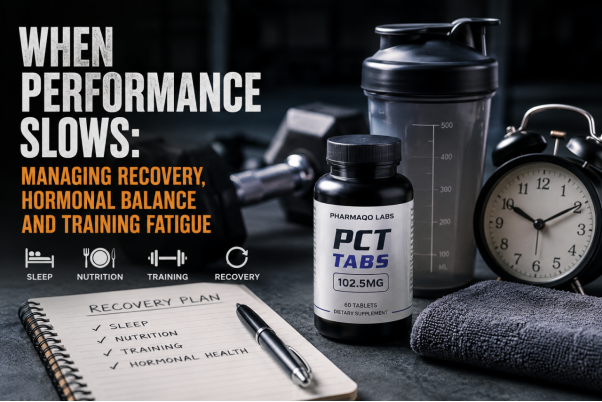
For example, the supplied product information for Pharmaqo Labs PCT Tabs 102.5mg x 60 describes the product in the context of post cycle recovery and hormonal balance. It also identifies potential side effects and advises consultation with a healthcare professional.
Those distinctions matter because a product description and a medical assessment serve completely different purposes.
A product page can describe a formulation.
A healthcare professional can evaluate whether a particular intervention is appropriate for an individual’s circumstances.
Monitoring What Is Happening Beyond the Gym
Training performance provides useful information, but it should not be the only source of feedback.
→ An Athlete can Monitor:
- Strength and Performance.
- Sleep Quality.
- Energy Levels.
- Mood.
- Appetite.
- Bodyweight Trends.
- Recovery between Sessions.
- General Wellbeing.
These observations can help identify patterns.
However, they do not replace medical testing when hormonal or other health concerns are present.
Blood work and professional assessment can provide information that cannot be obtained simply by looking in the mirror or comparing gym numbers.
Maintaining Muscle During Recovery
Concern about losing muscle can create additional pressure during recovery.
Athletes may respond by increasing training volume or attempting to maintain extremely aggressive diets.
This can be counterproductive.
Maintaining a sensible resistance training stimulus, adequate protein intake, sufficient energy, and appropriate recovery is generally a more sustainable approach.
Temporary changes in strength or muscle fullness do not necessarily represent permanent losses.
Bodyweight can also fluctuate because of changes in glycogen, hydration, food intake, and other factors.
Long-term trends are therefore more useful than day-to-day changes.
When Performance Should Take a Back Seat to Health
Performance goals are important, but they should not override significant health concerns.
Persistent fatigue, major changes in mood, sexual dysfunction, abnormal blood pressure, or other concerning symptoms warrant appropriate professional evaluation.
This becomes particularly important when prescription medicines or hormonal interventions are involved.
The objective of recovery should not simply be returning to previous gym numbers as quickly as possible.
It should be restoring a sustainable baseline from which future training can be approached more responsibly.
Building a Smarter Return to Training
A return to normal training can be gradual.
Instead of immediately attempting previous personal bests, athletes can assess how they respond to manageable workloads.
Training quality can be prioritised over maximum volume.
Recovery between sessions can be monitored.
Nutrition can remain consistent.
Sleep can receive greater attention.
This creates an environment where performance can rebuild without unnecessarily increasing fatigue.
Progress may not happen immediately, but a controlled return can provide a stronger foundation for longer-term development.
Why Recovery Planning Belongs in Every Training Cycle
Recovery should not only be considered when something goes wrong.
It can be incorporated into programme design from the beginning.
Training phases can include periods of reduced workload.
Nutrition can be adjusted according to the objective.
Sleep can be treated as a performance variable.
Health markers can be monitored when appropriate.
This makes recovery part of the overall strategy rather than an emergency response to declining performance.
The same principle applies regardless of whether an athlete is focused on strength, hypertrophy, conditioning, or general fitness.
Building Performance That Can Be Repeated
The strongest training strategy is not necessarily the one that produces the most dramatic short-term result.
It is the one that can be repeated.
An athlete who can train consistently, recover properly, maintain appropriate nutrition, and monitor their health has a much stronger foundation for long-term development than someone constantly moving between extreme phases.
Post cycle recovery adds another layer to that process because hormonal changes can make the transition more complicated.
Understanding physiology, recognising individual differences, and using objective information can help create a more responsible approach.
Recovery is not lost training time → It is part of the training process itself.
When fatigue is managed, sleep is protected, nutrition remains appropriate, and health is given proper attention, athletes have a better foundation for returning to productive training and continuing their development over the long term.
